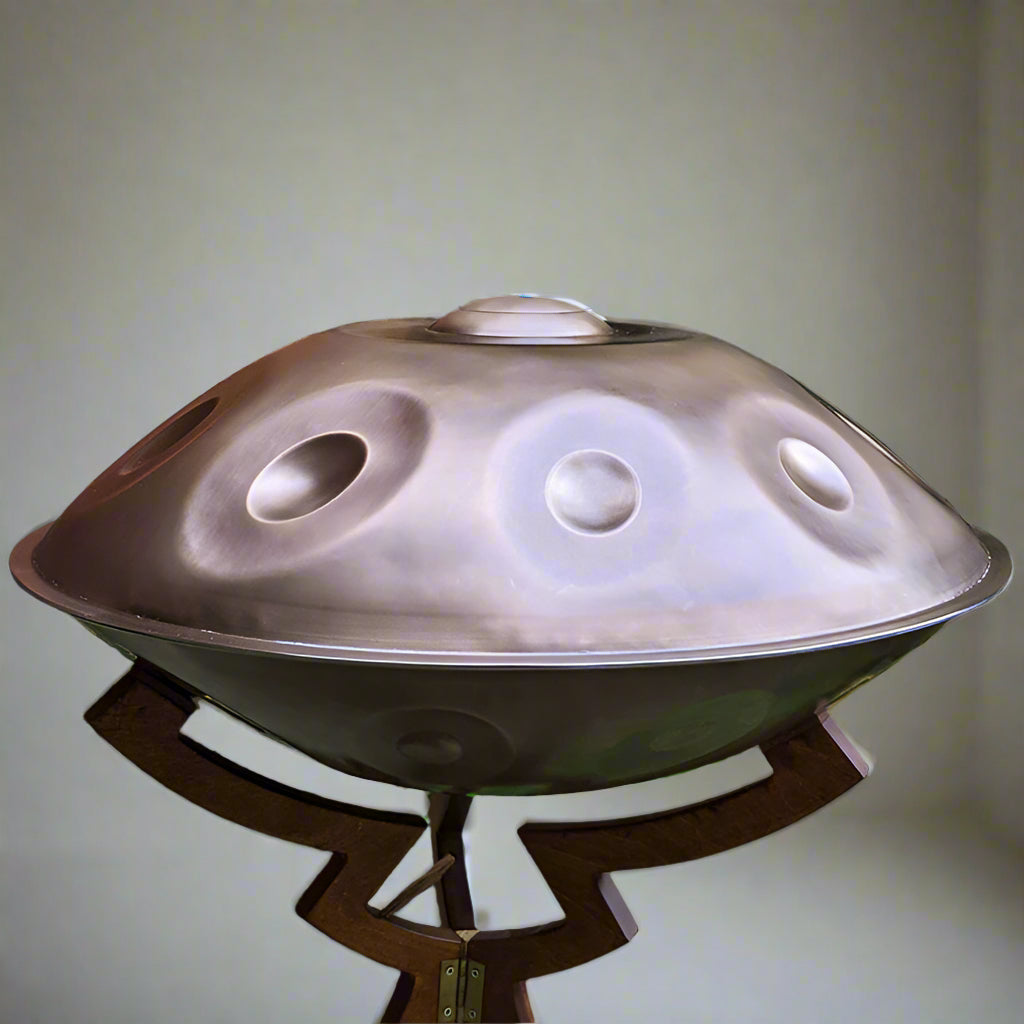
Mood description: Aegean
Standard tone sequence: C/ EGBCEF# GB
Atmosphere: Bright - Light - Sublime
Tonal Center: DING
Mode: Lydian - Major
Tone range: Pentatonic
Semitones: 4 - 3 - 4 - 1 - 4 -2 -1 - 4
In the South Indian Kartan music called "Raga Amrithavashini", the Aegean tuning is a divine scale which is said to induce showers of rain when sung.
The moods associated with it are grandeur, attraction, lightness and passionate joy. The combinations of notes in this scale are said to evoke inner vision, according to spiritual belief.
One feels a little reminded of the time of the ancient Greeks, who lived in the Aegean.
This pentatonic handpan scale is in the Lydian mode (major) and contains 2 semitone steps and is therefore a hemitonic pentatonic.
However, the semitone steps do not disrupt the flow, so that even beginners can quickly create great melodies intuitively. The selection of tones leaves nothing to be desired, and at the same time no note seems superfluous.
A special feature of Aegean is that the raised 4th note is only present in the upper octave. This note colors the scale in a Lydian way. This results in a very beautiful sound, as is often used in jazz music.
A major triad is built on the root note (DING), the fourth note forms the major seventh to the ding. After this fourth note on the pan, a semitone step leads back to the root note (an octave higher). The entire pentatonic scale is present in this upper octave. In comparison to the complete heptatonic Lydian mode, Aegean does not contain a 2nd and 6th degree. Since these are not crucial for Lydian, it can still be clearly assigned to this mode.
Possible tone sequences:
Scale with 10 tones: C/ EGBCEF# GBE
Scale with 11 tones: C/ EGBCEF# GBE (G)
Scale with 12 tones: C/ EGBCEF# GBE (GA)
Scale with 13 tones: C/ EGBCEF# GBE (GAB)
Scale with 14 tones: C/ E (F#) G (A) BC (D) EF# G (A) BE
Scale with 15 tones: C/ E (F#) G (A) BC (D) EF# G (A) B (C) E
Scale with 16 tones: C/ E (F#) G (A) BC (D) EF# G (A) B (CD) E
Scale with 17 tones: C/ E (F#) G (A) BC (D) EF# G (A) B (CD) E (G)
Scale with 18 tones: C/ E (F#) G (A) BC (D) EF# G (A) B (CD) E (GA)
Scale with 19 tones: C/ E (F#) G (A) BC (D) EF# G (A) B (CD) E (GAB)
* Bottom notes are additional tone fields on the bottom of the handpan and are written in round brackets e.g. (DE).
Mutant handpans have additional notes on the upper shell in the second row - between the chorus and the root note. Mutant notes are written in curly brackets, e.g. {DE}.
→ You can read a detailed article about Mutant & Bottom Note Handpans here: Blog post
→ Discover our full range of Mutant & Bottom Note Handpans here
We only list the standard layouts under "Possible note sequences". On request, our handpans can also be made with other notes and in other arrangements. Simply write an email with your request to: service@handpan.world
Suitable moods:
Very suitable for collaborative, improvised playing:
- A Celtic Minor / Amara
- G Sabye
- E Celtic Minor / Amara
- E Kurd
- E Integral
- D Raga Desh
- G RagaDesh
- A Pygmy
- E Low Pygmy
- E Magic Voyage
- Equinox
- A Jibuk
Also good for composing together:
- E Aeolian
- B Hijaz
- B Celtic Minor / Amara
- D Celtic Minor / Amara
- D Kurd
- B Mystic