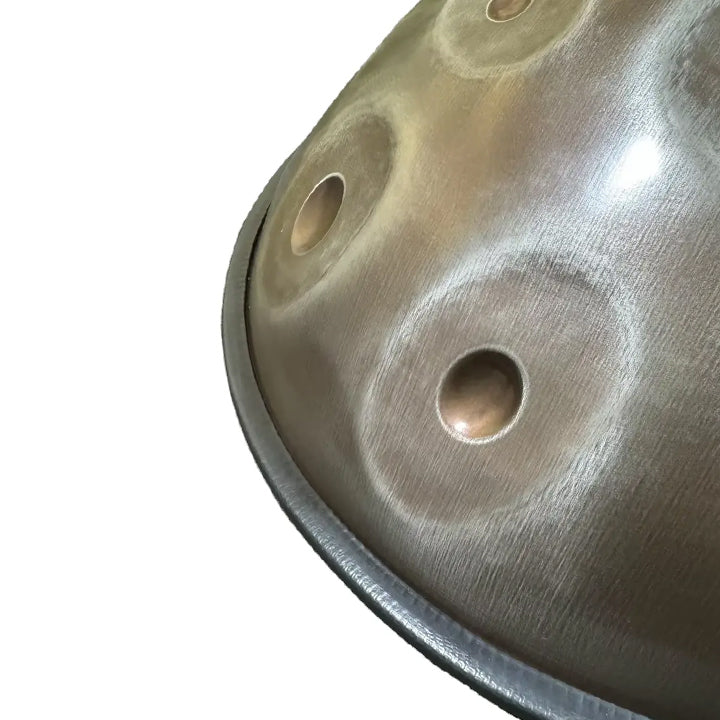
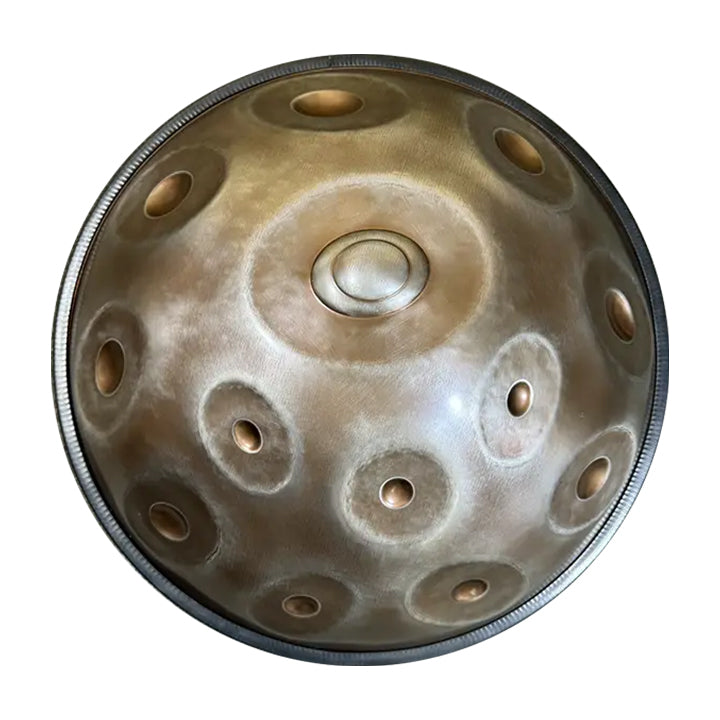
Tuning name: Celtic Minor
Synonym: Amara
Standard tone sequence: E/ B D E F# G A B D
Atmosphere: Melancholic - Archaic - Medieval
Mode: Minor - Aeolian
Tone range: Hexatonic
Semitones: 7-3-2-2-1-2-2-3
Tonal center: DING
Tuning description:
With this imperishable tone selection (Amara) you can conjure up sounds with ease that are reminiscent of times gone by thanks to pure fifths and fourths. This instrument would probably have found its place in spiritual ceremonies in Celtic times. Compared to the full Aeolian mode, the sixth degree is not present here, which makes this tuning somewhat more open. You can play very beautiful harmonies, especially in the upper range. This is one of the most popular tunings in the world of handpans.
Characteristic of Amara/Celtic Minor is the leap from the DING to the first note in the interval of a pure fifth (example D-A). This fifth leap immediately opens up the tonal space and gives context to the notes above it. The next note is a minor third above the fifth, which in turn is reminiscent of the natural tone row. From here there are two whole tone steps, a semitone step, two whole tone steps and the leap of the minor third to the highest note of the tuning, which results from the absence of the sixth degree (example D Celtic Minor: tone Bb).
This tuning sounds particularly archaic, as many pure intervals (fifth, fourth, octave) can be played, which were already used in the Middle Ages.
Another special feature results from the arrangement of the notes: in the example of D Celtic Minor, the notes on the right-hand side produce the triad of the root note, in this case D minor (A-D-F-A). On the left-hand side, however, all the notes of the major triad are one note below the root note, i.e. C major (C-E-G-C). When played harmonically, the sound impression of a major key can easily be created. This is probably the most common handpan tuning for a reason.
Possible tone sequences for E Celtic Minor:
Tone sequence with 9 notes: E/ B D E F# G A B D
Tone sequence with 10 notes:
Tone sequence with 11 notes:
Sequence with 12 notes:
Tone sequence with 13 notes:
Tone sequence with 14 notes:
Tone sequence with 15 notes:
Tone sequence with 16 notes:
Tone sequence with 17 notes:
Tone sequence with 18 notes:
Tone sequence with 19 notes:
*Bottom notes are additional tone fields on the underside of the handpan and are written in round brackets, e.g. (D E).
Mutant handpans have additional notes on the top shell in the second row - between the chorus and the root note. Mutant notes are written in curly brackets, e.g. {D E}.
→ You can read a detailed article on mutant & bottom-note handpans here: Blog post
→ Discover our full selection of mutant & bottom-note handpans here
We only list the standard layouts under "Possible tone sequences". On request, our handpans can also be made with other notes and in other arrangements. Simply send an email with your request to: service@handpan.world
Suitable moods:
Very suitable for playing together improvisationally:
Also suitable for composing together: