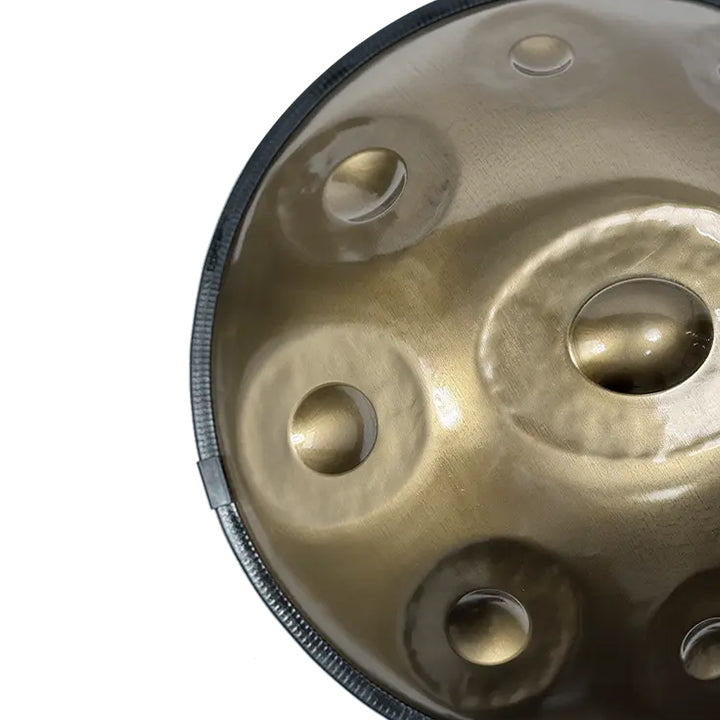
Mood description : Kurd
Synonyms : Aeolian / with root C# = Annaziska
Basic tone sequence (8+1): D/ A Bb CDEFGA
Effect : Warm - Mysterious - Dreamy
Tone range: Heptatonic
Mode :
Phrygian (tonal center 1st note) = major, or
Aeolian (tonal center: thing) = minor
Semitones: 7 - 1 - 2 - 2 - 2 - 3 - 2 - 2
Tonal center: DING or first tone
Description Handpan tuning D Kurd:
The Kurd tuning is, if you will, the natural minor variant of the handpan tunings . Due to its particularly harmonious composition of notes, it is particularly suitable for beginners . With them, you can play from calm and meditative to melancholic to powerful and cheerful. play everything with variety.
Even though this mood can sound very sentimental, you can create cheerful sounds with it. For example, the second and third notes each produce a major triad . Just be aware that the second and third notes are played at the same time. You can of course also use this tension consciously to spice up your playing so that the relaxation has a stronger effect afterwards.
This tuning is one of the first seven-tone scales to be tuned into a handpan and has become very popular through numerous viral videos on the Internet.
Origin and music theory of the Handpan tuning Kurd:
Kurd takes the name of the Arabic/Turkish maqam Kurd . This selection of tones also shares the arrangement of the tones with this maqam if one assumes that the tonal center is on the first tone in the circle. This creates the complete Phrygian mode, which is characterized by a semitone step (semitone) from the root note to the second note of the scale and is responsible for the mysterious sound of the scale .
However, an ambivalence remains, as the DING is a fifth below the first note and thus acts like a second tonal center, which allows the mode to change to Aeolian (natural minor). Depending on the playing style, you can switch between natural minor and Phrygian sound character . With Kurd you can play everything from calm and meditative to melancholic to powerful and cheerful, with a wide variety of styles.
Kurd shares with other minor variations (cf. Celtic Minor/ Integral) the jump of a fifth from the DING to the first tone. From this fifth step, assuming that the tonal center is the DING, one has all the tonal steps of a natural minor scale (Aeolian). A special feature of Kurd is the semitone step (semitone) between the first and second tone. This step is also present in the Maqam Kurd (Arabic or Turkish scale system) of the same name (cf. Semai Kurd), but also in the Phrygian mode . The Phrygian mode is used in jazz, psychedelic rock, flamenco and fado, but also in classical music .
Possible tone sequences of the Handpan Scale D Kurd:
Basic tone sequence with 9 notes: D/ A Bb CDEFGA
Sequence with 10 notes: D/ A Bb CDEFGAC
Sequence with 11 notes: D/ (FG) A Bb CDEFGA
12-note sequence: D/ (FG) A Bb CDEFGAC
Sequence with 13 notes: D/ (FG) A Bb CDEFGA (CD)
Tone sequence with 14 notes: D/ (FG) A Bb CDEFGAC (DE)
Mutant:
14-note sequence ( Mutant): D/ (FG) A Bb CDEFGAC {DE}
16-note sequence ( Mutant): D/ (FG) A Bb CDEFGAC {DE} (F)
* Bottom notes are additional tone fields on the bottom of the handpan and are written in round brackets e.g. (DE).
Mutant Handpans have additional notes on the upper bowl in the second row - between the choir and the root note. Mutant notes are written in curly brackets, e.g. {DE}.
→ You can read a detailed article about Mutant & Bottom Note Handpans here: blog post
→ Discover our full range of Mutant & Bottom Note Handpans here
We only list the standard layouts under "Possible note sequences". On request, our handpans can also be made with other notes and in other arrangements. Simply write an email with your request to: service@handpan.world
Which handpan tuning fits well with D Kurd:
Very suitable for collaborative, improvisational playing:
Also good for composing together: