HANDROMEDA Handpan D Kurd | Stainless Steel
Available options
Number of Tone Fields
Frequency
Design
Low stock: 2 left
Lieferbar innerhalb von 7 - 14 Werktagen.
Aktuell nicht vorrätig – Jetzt als Sonderanfertigung vorbestellen Unsere Handpans werden mit größter Sorgfalt und Präzision handgefertigt, um Dir höchste Klangqualität zu garantieren. Diese außergewöhnliche Qualität benötigt jedoch Zeit.Hier findest Du eine Übersicht der voraussichtlichen Fertigungsdauer:
• Standard-Instrumente (9-12 Noten, Grundtöne G3 bis B2): ca. 4 bis 10 Wochen
• Sonderanfertigungen mit tiefen Stimmungen (Grundton A2-E2): bis zu 3 Monate
• Bottomnote-Instrumente bis 15 Noten: bis zu 3,5 Monate
• Bottomnote-Instrumente bis 21 Noten: bis zu 4 Monate
• Bei den Herstellern Svaraa, Aya Sounds, NamiPan und Handromeda ist aufgrund hoher Nachfrage mit längeren Fertigungszeiten zu rechnen. Currently out of stock - pre-order now as a custom-made product Our handpans are handmade with the utmost care and precision to guarantee you the highest sound quality. However, this exceptional quality takes time.
Here you can find an overview of the expected production times:
•Standard instruments (9-12 notes, fundamental notes G3 to B2): approx. 4 to 10 weeks
•Custom-made items with low tunings (fundamental notes A2-E2): up to 3 months
•Bottom note instruments up to 15 notes: up to 3.5 months
•Bottom note instruments up to 21 notes: up to 4 months
•Due to high demand, longer production times can be expected for the manufacturers Svaraa, Aya Sounds, NamiPan and Handromeda.
HANDROMEDA
From Dreams, Harmonies Are Born
In the heart of vibrant São Paulo, where creativity meets the rhythm of life, Handromeda is a symbol of creativity and innovation. With a passion for creating exceptional instruments, Handromeda’s journey began with a vision to create absolute masterpieces of sound art.Founded by visionary artisan Vitor Luz, Handromeda embodies a tireless pursuit of self-expression and innovation, driven by the soulful vibration of metal.
Enchanted by the heavenly voice of the handpan, Vitor found his calling in the gentle embrace of singing steel. Since its founding in 2017, Handromeda has turned dreams into reality, making the dream of 'handpans for everyone' a reality. With a dedicated team of artisans who all share the same dream, Handromeda pushes every boundary and creates unique instruments that reflect the souls of people.
HANDROMEDA: Where Passion Meets Purpose and Melodies Unite Souls
“As we delve deeper into the art of handpan making, we unravel the secrets of steel and are constantly striving to rediscover the potential of these instruments. At Handromeda, we believe in the transformative power of music, in the profound impact it can have on life. Guided by this conviction, we not only create instruments but also strive to spread the magic of the handpan throughout the world.
Our vision goes beyond mere instrument making; we are committed to making the handpan the 'instrument of the century'. Through our actions, we support artists, businesses, projects, and manufacturers within the handpan community, thereby fostering a culture of collaboration and growth.
Join us on the journey to make our dreams come true, as we transform one handpan after another into sound.“
Height: 26cm / 28 cm
Weight: approx. 4.4kg
Material: Stainless steel
Tuning Name: Kurd
Basic Note Sequence: D/ A Bb C D E F G A
Character: Warm - Mysterious - Dreamy
Note Range: Heptatonic
Mode: Phrygian (tonal center on the 1st note ) = Major
or Aeolian (tonal center : B) = Minor
Tonal Center : DING or first note
Semitones : 7- 1 - 2 - 2 - 2- 3 - 2 - 2
Description of Kurd Tuning:
The Kurd tuning is, if you will, the natural minor variant of the handpan tunings. Due to its particularly harmonious arrangement of notes, it is especially well suited for beginners. With it, you can play everything from calm and meditative to melancholic, powerful, and joyful.
Even though this tuning can sound very sentimental, you can also create joyful soundscapes with it. For example, the second and third notes each form a major triad. Just be aware that the second and third notes will rub when played together; of course, you can also deliberately use this tension to add spice to your playing and make the subsequent relaxation feel even stronger.
This tuning is one of the first heptatonic tunings ever made and has become very well known through several videos on the internet.
Origin and Music Theory of the Kurd Tuning:
Kurd takes its name from the Arabic / Turkish Maqam Kurd. This maqam also shares the arrangement of notes with this tuning, assuming that the tonal center is on the first note in the circle. This creates the full Phrygian mode, which is characterized by a semitone step (semitone) from the root note to the second note of the scale and is responsible for the mysterious sound of the scale.
However, an ambiguity remains, as the DING is a fifth below the first note and thus acts as a second tonal center, which changes the mode to Aeolian (natural minor). Depending on the style of playing, you can thus switch between natural minor and Phrygian sound characters. With Kurd you can play everything from calm and meditative to melancholic, powerful, and joyful.
Kurd shares with other minor variations (cf. Celtic Minor/ Integral) the jump of a fifth from the DING to the first note. From this fifth step, assuming that the tonal center is the DING, you have all the steps of a natural minor scale (Aeolian). Kurd is particularly notable for the semitone step (semitone) between the first and second notes. This step is also present in the namesake Maqam Kurd (Arabic or Turkish scale system) (cf. Semai Kurd), but also in the Phrygian mode. The Phrygian mode is used in jazz, psychedelic rock, flamenco, and fado, but also in classical music.
Possible Note Sequences:
Basic 9-note sequence: D3/ A Bb C D E F G A
10-note sequence: D3/ A Bb C D E F G A C
12-note sequence: D3 /(F G)A Bb C D E F G A C
Mutant: D3/ A Bb C D E F G A C {D E}
13-note sequence: D3 /(E F G)A Bb C D E F G A C
14-note sequence: (Bb2 C3) D3 /(F G)A Bb C D E F G A C
Mutant: D3 /(F G)A Bb C D E F G A C {D E}
15-note sequence: D3 /(E F G)A Bb C D E F G A C {D E}
16-note sequence: D3 /(F G)A Bb C D E F G A C {D E} (F G)
17-note sequence: (Bb2 C3) D3 /(E F G)A Bb C D E F G A C {D E}
18-note sequence: (Bb2 C3) D3 /(F G)A Bb C D E F G A C {D E} (F G)
19-note sequence: (Bb2 C3) D3 /(F G)A Bb C D E F G A C {D E} (F G A)
*Notes in parentheses are "bottom notes" (notes on the lower shell of the handpan)
Upon request, these can also be made with other notes than indicated. Simply write an email with your request to: service@handpan.world
** Notes in curly brackets { } are installed in a second row on the top of the handpan
Matching Tunings:
Very suitable for playing together and improvising:
- F Sabye (Relative Major)
- F Major (Relative Major)
- D Celtic Minor / Amara
- G Celtic Minor / Amara
- D Aeolian
- Bb Aegean
- D Equinox
- D Magic Voyage
- D Integral
- D Pygmy
Also suitable for composing together:
- A Celtic Minor / Amara
- A Hijaz
- C Kurd
- C Celtic Minor / Amara
- F Ragadesh
Product Description
Product Description
HANDROMEDA
From Dreams, Harmonies Are Born
In the heart of vibrant São Paulo, where creativity meets the rhythm of life, Handromeda is a symbol of creativity and innovation. With a passion for creating exceptional instruments, Handromeda’s journey began with a vision to create absolute masterpieces of sound art.Founded by visionary artisan Vitor Luz, Handromeda embodies a tireless pursuit of self-expression and innovation, driven by the soulful vibration of metal.
Enchanted by the heavenly voice of the handpan, Vitor found his calling in the gentle embrace of singing steel. Since its founding in 2017, Handromeda has turned dreams into reality, making the dream of 'handpans for everyone' a reality. With a dedicated team of artisans who all share the same dream, Handromeda pushes every boundary and creates unique instruments that reflect the souls of people.
HANDROMEDA: Where Passion Meets Purpose and Melodies Unite Souls
“As we delve deeper into the art of handpan making, we unravel the secrets of steel and are constantly striving to rediscover the potential of these instruments. At Handromeda, we believe in the transformative power of music, in the profound impact it can have on life. Guided by this conviction, we not only create instruments but also strive to spread the magic of the handpan throughout the world.
Our vision goes beyond mere instrument making; we are committed to making the handpan the 'instrument of the century'. Through our actions, we support artists, businesses, projects, and manufacturers within the handpan community, thereby fostering a culture of collaboration and growth.
Join us on the journey to make our dreams come true, as we transform one handpan after another into sound.“
Specifications
Specifications
Height: 26cm / 28 cm
Weight: approx. 4.4kg
Material: Stainless steel
About the Tuning
About the Tuning
Tuning Name: Kurd
Basic Note Sequence: D/ A Bb C D E F G A
Character: Warm - Mysterious - Dreamy
Note Range: Heptatonic
Mode: Phrygian (tonal center on the 1st note ) = Major
or Aeolian (tonal center : B) = Minor
Tonal Center : DING or first note
Semitones : 7- 1 - 2 - 2 - 2- 3 - 2 - 2
Description of Kurd Tuning:
The Kurd tuning is, if you will, the natural minor variant of the handpan tunings. Due to its particularly harmonious arrangement of notes, it is especially well suited for beginners. With it, you can play everything from calm and meditative to melancholic, powerful, and joyful.
Even though this tuning can sound very sentimental, you can also create joyful soundscapes with it. For example, the second and third notes each form a major triad. Just be aware that the second and third notes will rub when played together; of course, you can also deliberately use this tension to add spice to your playing and make the subsequent relaxation feel even stronger.
This tuning is one of the first heptatonic tunings ever made and has become very well known through several videos on the internet.
Origin and Music Theory of the Kurd Tuning:
Kurd takes its name from the Arabic / Turkish Maqam Kurd. This maqam also shares the arrangement of notes with this tuning, assuming that the tonal center is on the first note in the circle. This creates the full Phrygian mode, which is characterized by a semitone step (semitone) from the root note to the second note of the scale and is responsible for the mysterious sound of the scale.
However, an ambiguity remains, as the DING is a fifth below the first note and thus acts as a second tonal center, which changes the mode to Aeolian (natural minor). Depending on the style of playing, you can thus switch between natural minor and Phrygian sound characters. With Kurd you can play everything from calm and meditative to melancholic, powerful, and joyful.
Kurd shares with other minor variations (cf. Celtic Minor/ Integral) the jump of a fifth from the DING to the first note. From this fifth step, assuming that the tonal center is the DING, you have all the steps of a natural minor scale (Aeolian). Kurd is particularly notable for the semitone step (semitone) between the first and second notes. This step is also present in the namesake Maqam Kurd (Arabic or Turkish scale system) (cf. Semai Kurd), but also in the Phrygian mode. The Phrygian mode is used in jazz, psychedelic rock, flamenco, and fado, but also in classical music.
Possible Note Sequences:
Basic 9-note sequence: D3/ A Bb C D E F G A
10-note sequence: D3/ A Bb C D E F G A C
12-note sequence: D3 /(F G)A Bb C D E F G A C
Mutant: D3/ A Bb C D E F G A C {D E}
13-note sequence: D3 /(E F G)A Bb C D E F G A C
14-note sequence: (Bb2 C3) D3 /(F G)A Bb C D E F G A C
Mutant: D3 /(F G)A Bb C D E F G A C {D E}
15-note sequence: D3 /(E F G)A Bb C D E F G A C {D E}
16-note sequence: D3 /(F G)A Bb C D E F G A C {D E} (F G)
17-note sequence: (Bb2 C3) D3 /(E F G)A Bb C D E F G A C {D E}
18-note sequence: (Bb2 C3) D3 /(F G)A Bb C D E F G A C {D E} (F G)
19-note sequence: (Bb2 C3) D3 /(F G)A Bb C D E F G A C {D E} (F G A)
*Notes in parentheses are "bottom notes" (notes on the lower shell of the handpan)
Upon request, these can also be made with other notes than indicated. Simply write an email with your request to: service@handpan.world
** Notes in curly brackets { } are installed in a second row on the top of the handpan
Matching Tunings:
Very suitable for playing together and improvising:
- F Sabye (Relative Major)
- F Major (Relative Major)
- D Celtic Minor / Amara
- G Celtic Minor / Amara
- D Aeolian
- Bb Aegean
- D Equinox
- D Magic Voyage
- D Integral
- D Pygmy
Also suitable for composing together:
- A Celtic Minor / Amara
- A Hijaz
- C Kurd
- C Celtic Minor / Amara
- F Ragadesh

Questions & answers when buying a handpan:
Reference to manual work on our Handpan instruments
Our handpans are elaborately crafted by hand. Even though our handpans are made with the utmost care and craftsmanship, natural differences in color, slight variations in design and minimal manufacturing marks, such as fine scratches or unevenness on the tone fields and the sound body, may occur.
Visible hammer marks, which are caused by the precise tuning of the instrument by hand, are characteristic features of handmade handpans. They are evidence of authentic craftsmanship and do not represent a quality defect. On the contrary, they emphasize the uniqueness of each instrument.
Pre-orders & custom-made products
Pre-orders:
Are you interested in a handpan that we don't currently have in stock? No problem, we can have your desired handpan made for you.
Custom-made products:
At Handpan.World you can order your handpan exactly as you want it - be it the scale, the note layout or other individual details.
Do you have a special scale or note layout in mind that we don't offer as standard? We can have your handpan made to your specifications by the manufacturer of your choice.
Contact us by email at service@handpan.world or by phone if you have any special requests.
Our handpans are manufactured with the utmost care and precision to guarantee the highest sound quality. However, this quality takes time. Below you will find an overview of the estimated production time for your handpan:
Estimated production time:
- Standard instruments (9-12 notes, root notes G3 to B2): approx. 4 to 10 weeks
- Custom-made instruments with low tunings (fundamental A2-E2): up to 3 months
- Bottomnote instruments up to 15 notes: up to 3.5 months
- Bottom-note instruments up to 21 notes: up to 4 months
- Longer production times are to be expectedfor the manufacturers Svaraa, Aya Sounds, NamiPan and Handromeda, in particular due to the high volume of orders.
Note: The stated production times are estimates and do not represent binding delivery dates. Additional factors such as shipping times or possible customs clearance may extend the delivery time.
The estimates are based on our previous experience and are provided without guarantee. Depending on the order situation, delays in the processes or unforeseen events, the actual production time may vary and may be shorter or longer.
You are welcome to contact us at any time to inquire about progress and estimated delivery times.
Note: All items not in stock are made separately at the customer's request and are considered custom-made in accordance with § 312 d para. 4 BGB .
Pre-orders in accordance with Article L 121-20-12 of the Consumer Code are expressly not offered.
Info & tips for buying a handpan
View all-
Buying used handpans: tips and information
Discover the pros and cons of buying used handpans and what to look out for. Get tips on price-performance and technical development for the best purchase.
Buying used handpans: tips and information
Discover the pros and cons of buying used handpans and what to look out for. Get tips on price-performance and technical development for the best purchase.
-
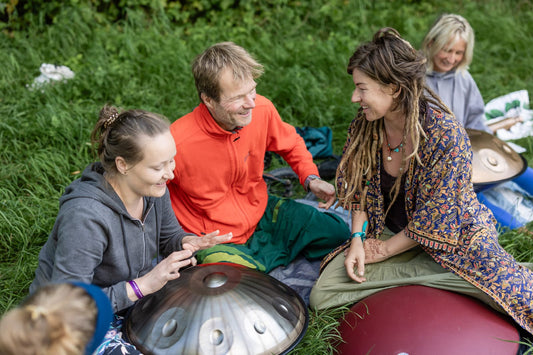
Handpan Drum Buying Guide
Welcome to our comprehensive buying guide for handpans – we want to help you find the right handpan for you by highlighting the crucial criteria: material, sound, quality, service and...
Handpan Drum Buying Guide
Welcome to our comprehensive buying guide for handpans – we want to help you find the right handpan for you by highlighting the crucial criteria: material, sound, quality, service and...
-
Which Her(t)z type are you?
Make your own subjective impression of the two vibration frequencies of 440Hz and 432Hz.
Which Her(t)z type are you?
Make your own subjective impression of the two vibration frequencies of 440Hz and 432Hz.
Handpan basic knowledge
-
Extended Scales Bottom Note and Mutant Handpans...
Extended Scales and Mutant Handpans are an exciting new development in the world of handpans. They offer you an expanded range of musical possibilities and open up new worlds of...
Extended Scales Bottom Note and Mutant Handpans...
Extended Scales and Mutant Handpans are an exciting new development in the world of handpans. They offer you an expanded range of musical possibilities and open up new worlds of...
-
The fascinating history of the handpan: from it...
The handpan, also known as the hang, is a relatively young instrument that has gained immense popularity in recent years. Its enchanting sound and meditative playing style have captivated people...
The fascinating history of the handpan: from it...
The handpan, also known as the hang, is a relatively young instrument that has gained immense popularity in recent years. Its enchanting sound and meditative playing style have captivated people...
-
Matching handpan tunings
We are often asked about the possibilities of matching handpan tunings. When it comes to buying a second handpan or two close people want to buy two suitable instruments together,...
Matching handpan tunings
We are often asked about the possibilities of matching handpan tunings. When it comes to buying a second handpan or two close people want to buy two suitable instruments together,...