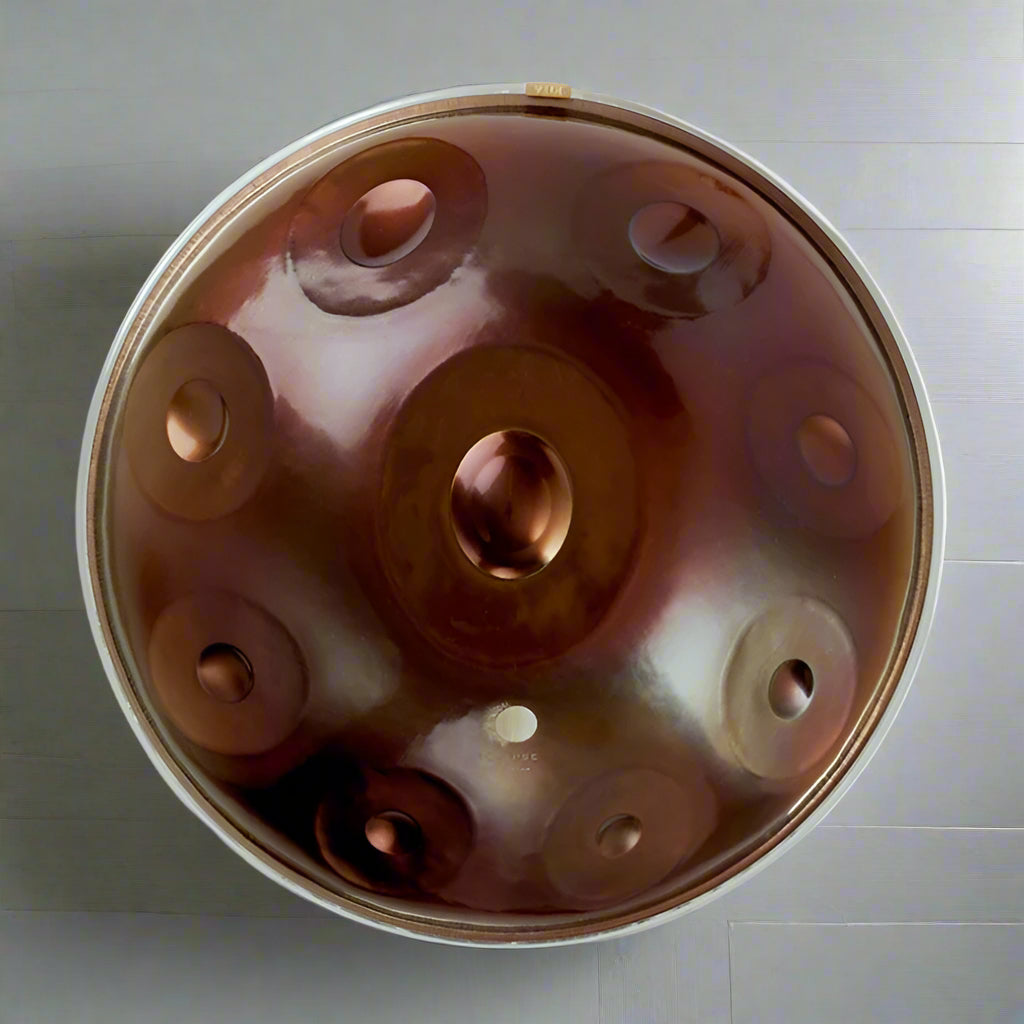
Mood name : Kurd
Basic tone sequence (8+1): D/ A Bb CDEFGA
Effect : Warm - Mysterious - Dreamy
Tone supply: Heptatonic
Mode : Phrygian (tonal center 1st note) = major
or Aeolian (tonal center: B) = minor
Tonal center: DING or first tone
Semitones: 7 - 1 - 2 - 2 - 2 - 3 - 2 - 2
Description Handpan Mood Kurd:
The Kurd tuning is, if you will, the natural minor variant of the handpan tunings. Due to its particularly harmonious composition of notes, it is particularly suitable for beginners. With them you can play everything from calm and meditative to melancholic to powerful and happy.
Even though this mood can sound very sentimental, it can certainly create happy sound images. For example, the second and third notes produce a triad in major. Just be aware that the second and third notes are played at the same time. You can of course also use this tension consciously to spice up your playing and make the relaxation have a stronger effect afterwards.
This tuning is one of the first seven-tone tunings to be built and has become very popular through some videos on the Internet.
Origin and music theory of the Kurd tuning of handpans:
Kurd takes the name of the Arabic/Turkish Maqam Kurd. This tone selection also shares the arrangement of the tones with this Maqam if one assumes that the tonal center is on the first tone in the circle. This creates the complete Phrygian mode, which is characterized by a semitone step from the fundamental tone to the second tone of the scale and is responsible for the mysterious sound of the scale.
However, there remains an ambivalence, since the DING is a fifth below the first tone and thus appears like a second tonal center, which allows the mode to change to Aeolian (natural minor). Depending on how you play, you can switch between natural minor and Phrygian sound characteristics. With Kurd you can play anything from calm and meditative to melancholic to powerful and happy.
Kurd shares with other minor variations (cf. Celtic Minor/Integral) the jump from a fifth from the DING to the first tone. From this fifth level, assuming that the tonal center is the THING, one has all the tonal steps of a natural minor scale (Aeolian). What is special about Kurd is the half-tone step (semitone) between the first and second tone. This step is also present in the Maqam Kurd (Arabic or Turkish scale system) of the same name (see Semai Kurd), but also in the Phrygian mode. The Phrygian mode is used in jazz, psychedelic rock, flamenco and fado but also in classical music.
Matching handpan tunings for D Kurd:
Very suitable for improvisational playing together:
Also suitable for composing together: